Amzgachfktch Commercial Ice Makers for Real Demand
Three under-counter and freestanding ice makers producing 100–110 lbs of cube ice per 24 hours, with 22 lbs of bin storage and self-cleaning cycles built in. Built for bars, home offices, coffee shops, and any space where running out of ice mid-shift isn't an option.

All Three Models at a Glance
100 lbs Ice Maker Dual Inlet
See on Amazon
110 lbs Ice Maker Dual Inlet
See on Amazon
100 lbs Ice Maker Alt Inlet
See on AmazonSide-by-Side Specifications
The three models overlap heavily on output and storage but differ in footprint, cycle yield, and best-fit installation scenario — the table below makes those differences clear.
| Model | Daily Output | Cubes per Cycle | Cycle Time | Bin Storage | Dimensions (W×D×H, inches) | Weight | Water Inlet Modes | Best For |
|---|---|---|---|---|---|---|---|---|
| CIM-AT32FT04 | 100 lbs/24H | 36 cubes | 12 minutes | 22 lbs | 13.38 × 13.58 × 26.38 | 42 lbs | 2 modes | Home bar, office, under-counter install |
| SKF-ATS40FT | 110 lbs/24H | 40 cubes | 12 minutes | 22 lbs | 13.39 × 13.78 × 26.18 | 42 lbs | 2 modes | Coffee shop, small restaurant, higher-volume under-counter use |
| CIM-AT32FT | 100 lbs/24H | 36 cubes | 12 minutes | 22 lbs | 28.54 × 15.94 × 15.94 | — | 2 modes | Countertop or freestanding tabletop placement, wider surface footprint |
If under-counter installation is your priority, the CIM-AT32FT04 and SKF-ATS40FT are the right shapes for that application — and if you're pushing toward the high end of daily demand, the SKF-ATS40FT's 40-cube cycle and 110 lbs/24H rating give you meaningful margin.
Matching Ice Maker Output to Your Actual Daily Demand
The rated output — 100 lbs/24H or 110 lbs/24H — tells you what the machine can produce under ideal conditions: roughly 70°F ambient air temperature and 50°F inlet water. If your space runs warmer than that, whether it's a summer bar, a busy kitchen, or a garage setup, plan on 80–85% of the rated figure as your real-world ceiling. That means the 100 lbs/24H models realistically deliver around 80–85 lbs on a hot day, and the 110 lbs/24H SKF-ATS40FT model delivers around 88–93 lbs.
Start with your actual daily demand, then add a 20% buffer before you pick a model. A home bar that burns through 40 lbs on a busy weekend night can work with either 100 lbs/24H model — you have runway. A small restaurant or catering setup clearing 80–90 lbs daily needs the 110 lbs/24H model, and should think carefully about ambient temperature in the kitchen before assuming full rated output.
Cycle time matters most for peak demand windows. All three models complete a production batch in 12 minutes — the CIM-AT32FT04 and CIM-AT32FT yield 36 cubes per cycle; the SKF-ATS40FT yields 40. If your bin gets drawn down fast during a lunch rush, the 40-cube cycle gives you a faster restock rate per batch. Run the math: at 12 minutes per cycle, you're getting five cycles per hour — 180 cubes from the 36-cube models, 200 cubes from the 40-cube model.
- Under 50 lbs daily demand: Either 100 lbs/24H model gives you comfortable headroom without over-speccing.
- 50–80 lbs daily demand: The 100 lbs/24H models work in cooler environments; in warm spaces, the 110 lbs/24H model is the safer call.
- 80–100 lbs daily demand: The 110 lbs/24H SKF-ATS40FT is your baseline; account for ambient temperature reducing real output.
- Above 100 lbs daily demand: A single unit in this line won't cover it reliably — consider two units or a higher-capacity commercial machine.
Where These Machines Actually Fit and How to Install Them
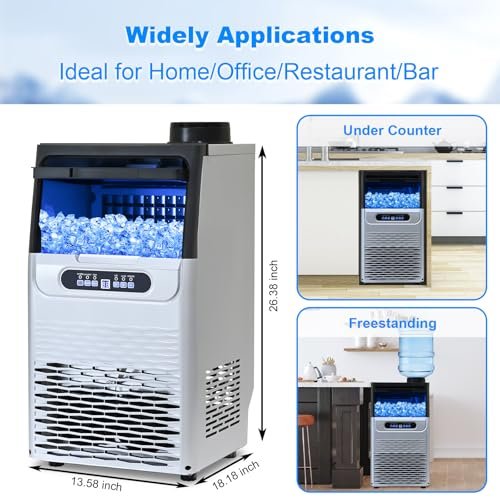
All three models are designed to work either freestanding or slid under a counter — but the footprints differ in one meaningful way. The CIM-AT32FT04 and SKF-ATS40FT are nearly identical in their counter-depth profile: both sit just under 13.4–13.8 inches deep and 13.4–13.8 inches wide, with a height of 26.18–26.38 inches. The CIM-AT32FT is dimensionally different — 28.54 inches wide and 16.34 inches deep, with a height of 15.94 inches — making it a wider, lower-profile unit that works better as a freestanding countertop or tabletop machine rather than an under-counter install.
For the two taller models (CIM-AT32FT04 and SKF-ATS40FT), a standard kitchen counter clearance of 34–36 inches is sufficient for under-counter installation. Leave 6 inches of clearance on the sides and back for airflow — ice makers generate heat during the freeze cycle, and restricting ventilation will drive up cycle times and reduce real-world output. Neither model should be tucked into a fully enclosed cabinet without ventilation cutouts.
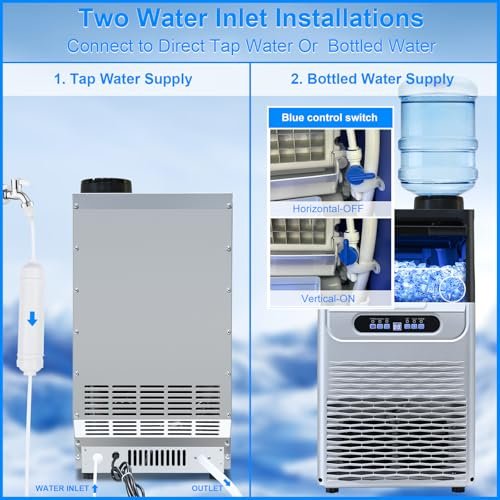
All three models support two water inlet modes, which means you can connect to a direct water line or use manual fill depending on your setup. A direct water line connection is the right call for any high-volume daily use — manual fill on a machine running 100+ lbs per day becomes a real operational burden. The included water filter should be installed at setup and swapped out on the manufacturer's recommended schedule; unfiltered hard water accelerates scale buildup on the evaporator and shortens the machine's service life.
- Home bar or office breakroom: CIM-AT32FT04 or CIM-AT32FT — 100 lbs/24H, 36-cube cycle, compact footprint.
- Coffee shop or small restaurant: SKF-ATS40FT — 110 lbs/24H, 40-cube cycle, slightly higher per-batch yield.
- Under-counter install: CIM-AT32FT04 or SKF-ATS40FT — both clear standard counter heights at under 26.4 inches tall.
- Countertop or freestanding tabletop: CIM-AT32FT — wider, lower-profile design suits open surface placement.
- High-temperature environments (garage, outdoor bar): Direct water line strongly recommended; budget for reduced output.
Keeping Your Ice Maker Running Clean and Efficiently
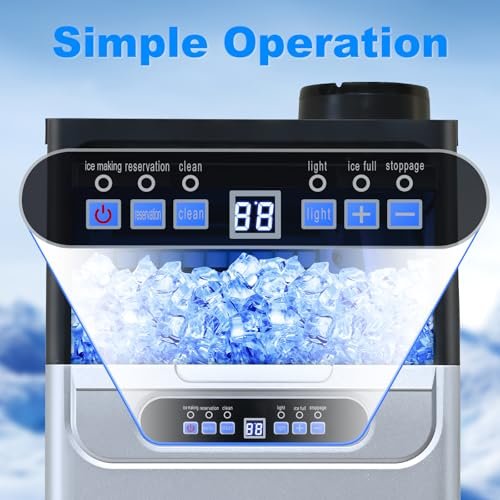
All three models include an auto self-cleaning cycle — run it at least once every two weeks under normal use, or weekly if your water supply has moderate to high mineral content. The cleaning cycle flushes the water system and helps prevent scale deposits on the evaporator plates, which are the most common cause of reduced ice production and off-tasting cubes. It takes under five minutes to initiate and runs automatically from there.
Descaling is a separate step from the self-cleaning cycle and matters more in hard-water areas. Use a food-safe ice machine descaler every one to three months depending on your water hardness. Signs you're overdue: longer cycle times, smaller or misshapen cubes, or a noticeable drop in daily output. Catching scale buildup early is far less costly than replacing an evaporator.
A few habits that extend service life across all three models:
- Replace the water filter on schedule. All three models ship with a water filter — don't skip the replacement interval. A clogged filter restricts flow, slows cycles, and stresses the pump.
- Keep the condenser coil clear. Dust and grease accumulation on the condenser reduces heat exchange efficiency. Wipe it down every month in a kitchen environment, every two to three months in a cleaner space.
- Don't block the air vents. These machines rely on air-cooled condensers. Side and rear clearance isn't optional — it's part of keeping the machine at rated output.
- Empty and dry the bin if the machine will be off for more than a few days. Standing water in a warm, enclosed bin is a bacteria and mold risk. Leave the door propped open during extended shutdowns.
- Check the water inlet connection periodically. A slow drip at the inlet valve fitting can go unnoticed and cause floor damage over time — inspect the connection every few months.
Frequently Asked Questions
Is 100 lbs of ice per day actually enough for a home bar, or do I need the 110 lbs model?
For most home bars, 100 lbs/24H is more than sufficient — the question is what your peak demand looks like in a single evening versus spread across the full day. A party of 20 people might consume 30–40 lbs in a few hours; the 22 lbs bin won't hold all of that at once, but the machine replenishes 36 cubes every 12 minutes, which adds up to roughly 15–18 lbs per hour of continuous production. If you're hosting large events frequently and want a faster restock rate after a big draw-down, the SKF-ATS40FT's 40-cube cycle and 110 lbs/24H rating give you extra buffer — especially if your space runs warm.
Can I use these ice makers without connecting to a water line, or do they require a plumbed connection?
All three models support two water inlet modes — direct water line connection or manual fill. Manual fill is workable for low-volume use, but for any setup producing close to the 100–110 lbs/24H rated output, manual fill becomes a real burden: you'd be refilling the reservoir multiple times a day. A direct water line connection is the practical choice for daily commercial or heavy home use. The included components vary by model — check what's in the box for your specific unit before assuming a supply line is included.
How much does warm ambient temperature actually affect output?
Meaningfully. The rated output figures — 100 lbs/24H and 110 lbs/24H — are measured at approximately 70°F ambient air temperature with around 50°F inlet water. In a hot kitchen, a summer garage, or an outdoor bar setup where temperatures push 85–90°F, expect real output to drop to roughly 80–85% of the rated figure. That's 80–85 lbs for the 100 lbs/24H models and around 88–93 lbs for the 110 lbs/24H SKF-ATS40FT. Plan your demand math around those adjusted numbers if your environment runs warm.
What's the difference between the CIM-AT32FT04 and the CIM-AT32FT — they look nearly identical on paper?
Both produce 100 lbs/24H with 36 cubes per 12-minute cycle and 22 lbs of bin storage. The key difference is physical footprint. The CIM-AT32FT04 is a tall, narrow under-counter unit — 13.38 inches wide by 26.38 inches tall — designed to slide beneath a standard counter. The CIM-AT32FT is a wide, low-profile unit — 28.54 inches wide by roughly 15.94 inches tall — better suited to countertop or freestanding tabletop placement where you have horizontal surface space. Pick based on where the machine is going, not just the output numbers.
How often does the self-cleaning cycle need to run, and does it stop ice production while it runs?
Under normal use, run the auto self-cleaning cycle at least every two weeks — weekly if your water has noticeable mineral content. Yes, the machine pauses ice production during the cleaning cycle, so schedule it during a low-demand window rather than right before a dinner service. The cycle itself takes under five minutes to initiate and runs automatically. Self-cleaning handles the water system flush, but it doesn't replace periodic descaling — in hard-water areas, use a food-safe descaler every one to three months to prevent evaporator scale buildup that cleaning cycles alone won't clear.
Do these machines need to be vented or exhausted to the outside like some commercial units?
No external venting is required — all three models use air-cooled condensers that exhaust heat into the surrounding space rather than requiring a duct to the outside. What they do need is clearance: at least 6 inches on the sides and back for airflow. Blocking that clearance by pushing the unit flush against walls or into a sealed cabinet will restrict heat exchange, drive up cycle times, and reduce real-world output. In a kitchen where ambient heat is already a concern, the clearance requirement is even more important to follow.